

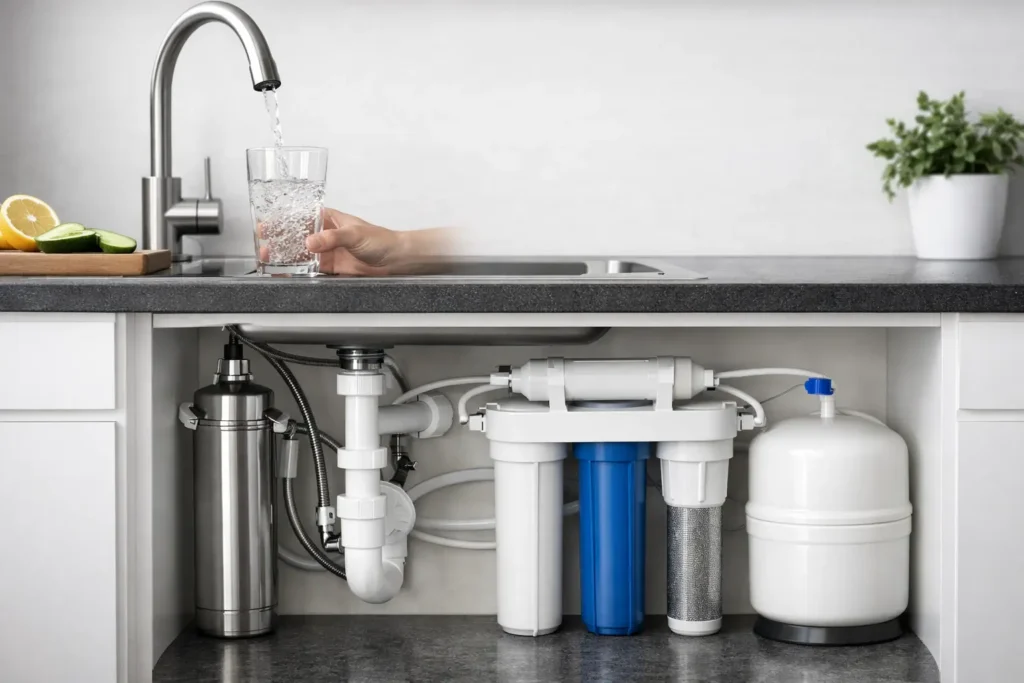
If your tap water tastes a little off, leaves white spots on glasses, or makes you second-guess filling a reusable bottle, an under-sink filter is one of the simplest upgrades you can make at home. The best under sink water filters clean up taste and odor, reduce common contaminants, and do it without taking over your countertop.
This is a category where the wrong pick gets annoying fast. Some filters are easy to install but expensive to maintain. Others remove more contaminants but slow your water flow to a trickle. The smart buy depends on your water, your sink setup, and how much effort you want to put into upkeep.
What makes the best under sink water filters worth buying
For most households, the appeal is straightforward. You get filtered water from a dedicated faucet or, in some cases, straight from your existing cold-water line. That means better-tasting water for drinking, cooking, coffee, and pet bowls without hauling pitchers in and out of the fridge.
They also tend to hit a practical middle ground. Pitcher filters are cheap and easy, but they are slow and limited. Whole-house systems are powerful, but they cost more and are harder to install. Under-sink filters give you a more noticeable upgrade where it matters most: the water you actually consume.
The catch is that not every system solves the same problem. A carbon filter aimed at chlorine and odor will not do the same job as a reverse osmosis system designed to reduce a wider range of dissolved solids. That is why spec sheets matter here, but so does real-life usability.
How to choose the best under sink water filters for your home
Start with your water, not the marketing. If your main complaint is taste or smell, a standard multi-stage carbon system is usually enough. If you are dealing with harder water, elevated lead concerns, or you simply want broader contaminant reduction, reverse osmosis becomes more compelling.
Your kitchen setup matters too. Some systems need a separate faucet, which means drilling if your sink or countertop does not already have an open hole. Others connect directly to your cold-water line and keep the look cleaner. If cabinet space is tight, tankless systems have a real advantage.
Then there is maintenance. Filter replacement costs add up over time, and the cheapest unit on day one is not always the cheapest to own. We generally look for systems with clearly labeled replacement schedules, easy cartridge swaps, and filters that are easy to find. That is the kind of stuff that keeps a good product from turning into a neglected one.
9 best under sink water filters to conside
1. Waterdrop G3P800
If you want a premium reverse osmosis system with strong performance and a modern, compact design, this is one of the strongest options in the category. It is tankless, which saves cabinet space, and it filters quickly compared with many older RO systems.
The big selling point is convenience. Filter changes are simple, the system looks cleaner under the sink, and the water flow is better than many people expect from reverse osmosis. The trade-off is price. This is not the entry-level choice, but it makes sense for shoppers who want high filtration performance without the bulky tank setup.

2. APEC ROES-50
This is the kind of reverse osmosis filter people buy when they want proven performance more than sleek design. It has been around for years, and there is a reason it keeps showing up on recommendation lists. It is dependable, effective, and widely supported with replacement parts.
It does take up more room because it uses a storage tank, and the install is a little less elegant than newer tankless systems. Still, for value-minded buyers who want strong contaminant reduction from a known system, it remains a smart pick.

3. CuZn UC-200
Not everyone wants reverse osmosis. If your tap water is municipally treated and your main goal is improving taste, reducing chlorine, and keeping minerals in the water, the CuZn UC-200 is a strong alternative.
It connects to the existing cold-water line, so you do not need a separate faucet. That makes it easier to live with day to day. It is also known for long filter life, which helps on ongoing cost. Just be clear on its role: this is not the right system if you need the broader contaminant reduction that RO can provide.

4. Aquasana AQ-5300+
Aquasana has built a solid reputation by balancing performance with mainstream usability, and this model fits that approach well. It is a good choice for households that want a certified multi-stage filter without committing to a larger reverse osmosis system.
It reduces a broad set of contaminants while keeping a relatively compact footprint. Replacement costs are not the lowest, but the system is approachable for first-time buyers and works well when your priorities are taste, odor, and everyday drinking water quality.

5. Waterdrop TSA 8 Layer
This style of direct-connect under-sink filter appeals to shoppers who want straightforward installation and cleaner-tasting water without adding a separate faucet. It is compact, budget-friendlier than RO options, and practical for renters or homeowners who want a lighter-lift upgrade.
The reason to choose it is simplicity. The reason to skip it is if you need more aggressive filtration for specific water quality issues. This is a convenience-first option, not a maximum-filtration system.

6. Frizzlife PD600-TAM3
This is another tankless reverse osmosis model worth a look, especially if mineral balance matters to you. One complaint people have about standard RO systems is that they can flatten taste by removing beneficial minerals along with everything else. Models like this try to address that with remineralization.
That does not make it automatically better for everyone, but it can improve taste for households that find regular RO water too stripped down. It is also space-efficient and easier to maintain than many traditional RO systems.


PO-STORE
Check out our store for a wider selection of everyday essentials.

7. iSpring RCC7AK
The iSpring RCC7AK is a value-focused reverse osmosis system that adds an alkaline remineralization stage. It is a popular middle-ground option for buyers who want broad filtration and a more balanced water taste without jumping to the highest-priced premium models.
Like most tank systems, it needs room under the sink and a bit more patience during installation. But if you want a feature-rich RO setup at a more approachable price, this one deserves a close look.

8. Clearly Filtered 3-Stage Under the Sink System
For shoppers who care deeply about broad contaminant claims but still prefer a non-RO format, Clearly Filtered stands out. It is designed to target a wide range of impurities while staying relatively simple to use.
The strength here is peace of mind and broad filtration coverage in a three-stage system. The trade-off is cost. Replacement filters are not cheap, so it makes the most sense for buyers who prioritize filtration depth over long-term budget savings.

9. Brondell Coral UC300
This is one of the better picks for households that want an accessible, low-hassle under-sink filter from a recognizable home-wellness brand. It is compact, practical, and designed for solid everyday performance rather than maximum specs.
That can actually be a plus. Many people do not need a highly technical system. They just want water that tastes better and feels more trustworthy. In that lane, the UC300 is easy to recommend.

Reverse osmosis vs. standard filtration
This is usually the decision that narrows the field fastest. If you want the broadest contaminant reduction, reverse osmosis is hard to beat. It is especially useful when total dissolved solids are high or when you want extra reassurance about lead, arsenic, nitrates, or similar concerns.
But RO is not automatically the best fit. It costs more, installation is usually more involved, and some systems waste more water during filtration. Standard under-sink filters are often easier to install, cheaper to maintain, and perfectly adequate for improving city water that already meets safety standards but tastes unpleasant.
A lot of shoppers do better with a realistic question: do you need the strongest filtration available, or do you need a convenient system you will actually maintain? That answer changes the shortlist quickly.
Installation and maintenance matter more than most buyers expect
A strong system on paper can still be a poor fit if replacing filters is awkward or if your cabinet layout is cramped. Before you buy, measure the space under your sink, check whether you have a spare faucet hole, and think about whether you are comfortable turning off valves and connecting water lines.
Maintenance should also be part of the budget. Some filters last six months, some closer to a year, and some much longer. What matters is not just lifespan, but replacement cost and ease. If the process is frustrating, people put it off. That is when performance drops.
For PO-Store readers, the safest recommendation is usually the one that balances filtration claims with ownership reality. You want a system that solves your water problem and still feels easy to live with six months later.
Which of the best under sink water filters is right for you?
If you want the strongest filtration and a more premium setup, a tankless RO model like the Waterdrop G3P800 or Frizzlife PD600-TAM3 makes sense. If you want proven RO value, the APEC ROES-50 and iSpring RCC7AK are safer budget-conscious bets. If your water is already decent and you mainly want better taste, less chlorine, and easier installation, direct-connect options like the CuZn UC-200 or Waterdrop TSA 8 Layer are often the better buy.
The right choice is usually less about chasing the most features and more about matching the filter to your water, your kitchen, and your patience for upkeep. Get that part right, and filtered water becomes one of those home upgrades you stop thinking about because it simply makes everyday life easier.


Pingback: Air Purifier for Pets Guide: What to Buy | PO‑STORE