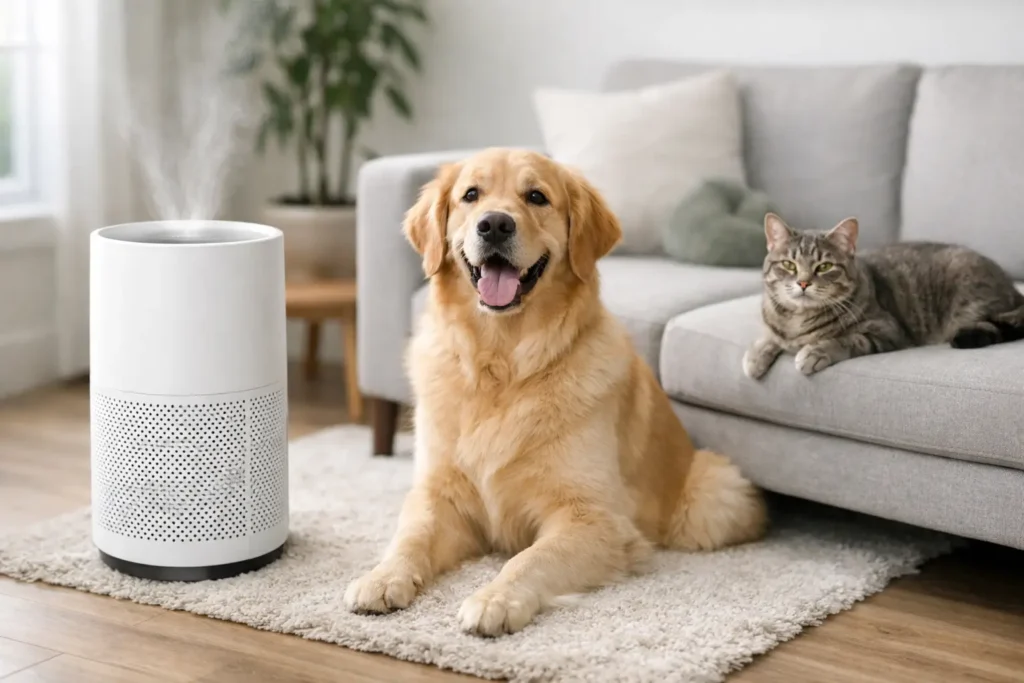
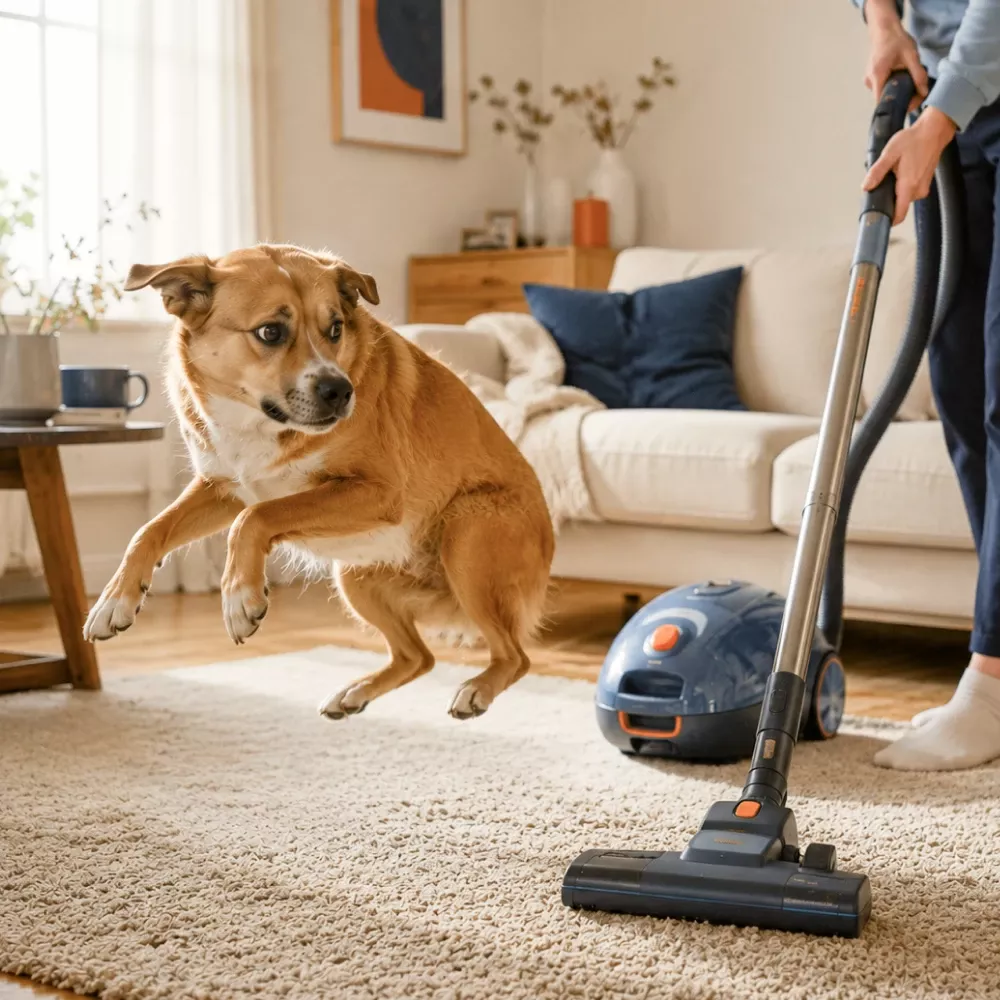

You notice it first in the places your pet loves most – the couch corner covered in fur, the hallway with that faint dog smell, the bedroom where allergies somehow feel worse at night. A good air purifier can help, but pet owners often end up paying for flashy features that do very little. This air purifier for pets guide focuses on what actually improves the air in a real home with shedding, dander, litter dust, and everyday odors.
What an air purifier can and can’t do for pet homes
An air purifier can reduce airborne pet dander, trap some fur before it settles, and help with lingering smells from dogs, cats, litter boxes, and beds. If someone in your home has mild allergies, that can make a noticeable difference, especially in bedrooms and smaller shared spaces. It can also help cut down on dust that seems to multiply when pets are indoors more often.
What it cannot do is replace cleaning. If pet hair is building up on floors, upholstery, and vents, an air purifier alone will not solve the problem. It also will not remove odors from carpets that need washing, litter boxes that are overdue for scooping, or pet beds that haven’t been cleaned in weeks. Think of it as support, not a substitute.
That distinction matters because many buyers expect instant results and end up disappointed. The best outcome usually comes from pairing a purifier with regular vacuuming, brushing, laundry, and decent ventilation.
Air purifier for pets guide: the features that matter most
If you want to shop smarter, start with filtration. For pet households, a True HEPA filter is the benchmark worth paying for. It captures very small particles, including dander and fine dust, and it is much more meaningful than vague claims like “HEPA-type” or “HEPA-like.” Those phrases often sound close enough, but performance can be very different.
Activated carbon matters too, especially if odor control is one of your main reasons for buying. Pet smells are not just particles floating in the air. Many are gases and volatile compounds, and carbon is what helps absorb them. A purifier with a weak carbon layer may help with dander but still leave you wondering why the room smells the same.
Room size is another big one. Many people buy too small and blame the machine. If the purifier is rated for a small office and you put it in a large living room with two dogs, it will struggle. For pet homes, it often makes sense to size up rather than buy the bare minimum, because dander and odor create a heavier workload than a low-traffic room without pets.
Noise matters more than it seems on a product page. A purifier may have great performance at its highest speed, but if it sounds like a box fan all day, you probably won’t use that setting. For bedrooms, home offices, or shared family rooms, steady low-to-medium performance is usually more realistic than relying on turbo mode.
Filter replacement cost is where many “good
The most common mistakes pet owners make
The first mistake is buying based on scent claims alone. “Odor eliminating” sounds great, but if the purifier skimps on particle filtration, you may still have dander circulating around the room. Odor control and allergen control are related, but they are not the same thing.
The second is placing the purifier in the wrong location. Tucking it behind a chair, under a shelf, or in a corner full of pet beds limits airflow. These machines need breathing room. If you want better results, put the purifier where air can circulate freely and where your pet actually spends time.
Another mistake is running it only when guests come over or when the room smells bad. Air purification works best as an ongoing habit. In homes with pets, continuous use on a quieter setting is usually more effective than turning it on occasionally at full blast.
Then there’s the maintenance issue. Filters fill up faster in pet homes. If the pre-filter is covered in hair and dust, performance drops. Even a strong machine becomes mediocre when upkeep gets ignored.
How to choose the right purifier for your home
Start with your biggest problem. If allergies are the priority, focus on strong HEPA filtration and a unit sized correctly for the room where symptoms are worst. For many households, that is the bedroom, because you spend hours there and notice air quality more overnight.
If odor is the main issue, especially with cats, litter boxes, or multiple pets, pay closer attention to carbon filtration. Not every purifier with carbon performs equally well. Thin carbon sheets are better than nothing, but heavier carbon setups generally do more.
If you have a large open-concept space, one purifier may not cover everything as well as you hope. In that case, two smaller units placed strategically can sometimes work better than one oversized machine pushed into a single corner. It depends on layout, airflow, and where your pets spend most of their time.
For light shedders or one-pet households, a mid-range model is often enough. For multiple pets, heavy shedding breeds, or homes with allergy-sensitive family members, it is worth moving up in performance and filter quality rather than buying the cheapest acceptable option.
Smart features are optional. Auto mode, air quality sensors, and app control can be convenient, but they are not what makes a purifier effective. We would take strong filtration, reasonable noise, and affordable replacement filters over flashy connectivity every time.
Where an air purifier helps most in a pet household
Bedrooms are usually the highest-value placement, especially if allergies disrupt sleep. Keeping one running overnight can reduce the fine particles that settle and recirculate while the room is closed up.
Living rooms come next, since that is where pets and people tend to share space for long stretches. If your dog naps on the rug or your cat claims the sofa, this area sees plenty of dander and trapped smell.
Near litter boxes, a purifier can help, but placement needs some care. You do not want it so close that it pulls litter dust constantly into the system, yet close enough to improve odor and air quality in the area. Good litter habits still matter more than any machine.
Home offices are also worth considering if you work from home with pets nearby. Even mild airborne irritation becomes more noticeable when you are sitting in one room for hours.
Maintenance is part of performance
A purifier for a pet home needs more attention than one in a low-dust apartment. Pre-filters should be checked often, because pet hair can build up fast. If the model allows vacuuming or rinsing the pre-filter, that can help extend the life of the main filter.
Main filters still need replacing on schedule, and sometimes sooner if you have multiple pets or run the machine constantly. If a brand promises long filter life, read that as a best-case estimate, not a guarantee. Real-world use is usually harder on filters than the packaging suggests.
It also helps to keep expectations realistic about odor. Even the right purifier works better when paired with practical upkeep – washing pet beds, cleaning soft surfaces, grooming regularly, and staying ahead of litter or accident cleanup.
Who should spend more, and who probably shouldn’t
If anyone in your home has allergies, asthma sensitivity, or strong reactions to pet dander, spending more on a proven purifier is usually justified. The same goes for homes with multiple pets, heavy shedders, or rooms that hold onto odor.
If your main issue is visible fur on the floor, spend on a better vacuum first. An air purifier can help with airborne particles, but it is not the first tool for tumbleweeds of dog hair under the dining table. Likewise, if your space is tiny and your pet-related air issues are occasional, a solid mid-priced model is often the more sensible buy.
That is where a recommendation-led approach matters. The right pick is not always the most expensive or the one with the longest feature list. It is the one that fits your room, your pet load, and the kind of problem you are actually trying to solve.
At PO-Store, that is the lens we trust most: less marketing noise, more useful filtering of the facts. If you buy with the right expectations, an air purifier can make your home feel fresher, sleep easier, and cut down on the daily low-level irritation that comes with loving animals indoors. Choose the machine that matches your real life, and it will do far more than a trendier one that only looks good on paper.
Buy on AmazonWe recommend the Coway AP-1512HH because it is an absolute workhorse that consistently outperforms units twice its price in real-world smoke and pollen testing. It pairs a certified True HEPA filter with a hyper-intelligent Eco Mode. Once its built-in particle sensor tracks clean air for 30 consecutive minutes, the unit automatically shuts down its fan completely to save power, waking itself back up only if ambient pollution levels spike.
- Coverage: Up to 361 sq ft (AHAM verified) / up to 1,748 sq ft in 1 hour
- Filtration: 4-Stage (Washable Pre-filter, Odor Carbon, True HEPA, Vital Ionizer)
- Key Feature: Automated Eco-Mode energy saver, real-time LED air quality index
Buy on AmazonWhy PO-Store Recommends It
We recommend the Levoit Core 300-P as our best bang-for-your-buck option for small-to-medium rooms like offices and bedrooms. Packed with a hefty 45 grams of granular carbon inside its 3-stage cylindrical filter (a huge step up from the thin, sprayed mesh filters typical at this price point), it scrubs out stagnant cooking smells, pet odors, and wildfire smoke faster than anything else in its weight class. It packs a dedicated child lock and an ultra-quiet sleep mode directly onto its clean touchscreen face.
- Coverage: Optimal up to 220 sq ft / handles up to 1,073 sq ft in 1 hour
- Filtration: 360° Pleated 3-in-1 (Pre-filter, True HEPA-grade, ARC Formula Carbon)
- Weight: 7.5 lbs (Highly portable tabletop profile)
Buy on AmazonWhy PO-Store Recommends It
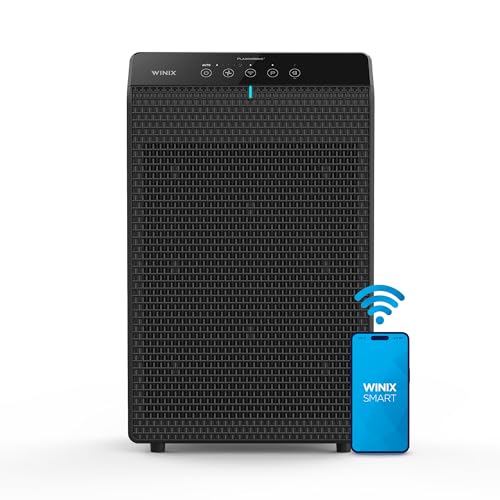
We recommend the Winix 5520 as a sleek, highly space-efficient option for large rooms where you want powerful air circulation without a massive appliance taking over the corner. It manages to pack a 4-stage purification system—featuring a washable pre-filter, advanced odor control carbon, and a True HEPA filter—into a significantly smaller, more compact footprint than older legacy console designs. It supports full Wi-Fi app connectivity and uses an on-board smart gas sensor to actively track volatile organic compounds (VOCs) and cooking odors, scaling its fan speed automatically to clear the air.
- Coverage: Up to 392 sq ft (AHAM verified) / up to 1,882 sq ft in 1 hour
- Filtration: 4-Stage (Washable Fine-Mesh Pre-filter, Advanced Odor Control Carbon, True HEPA, PlasmaWave Technology)
- Smart Ecosystem: Winix Smart App control, automated smart sensor tracking



Pingback: 7 Best Digital Photo Frames for Your Home | PO‑STORE
Pingback: Robot Vacuum vs Cordless Vacuum: Which Is Best? | PO‑STORE