

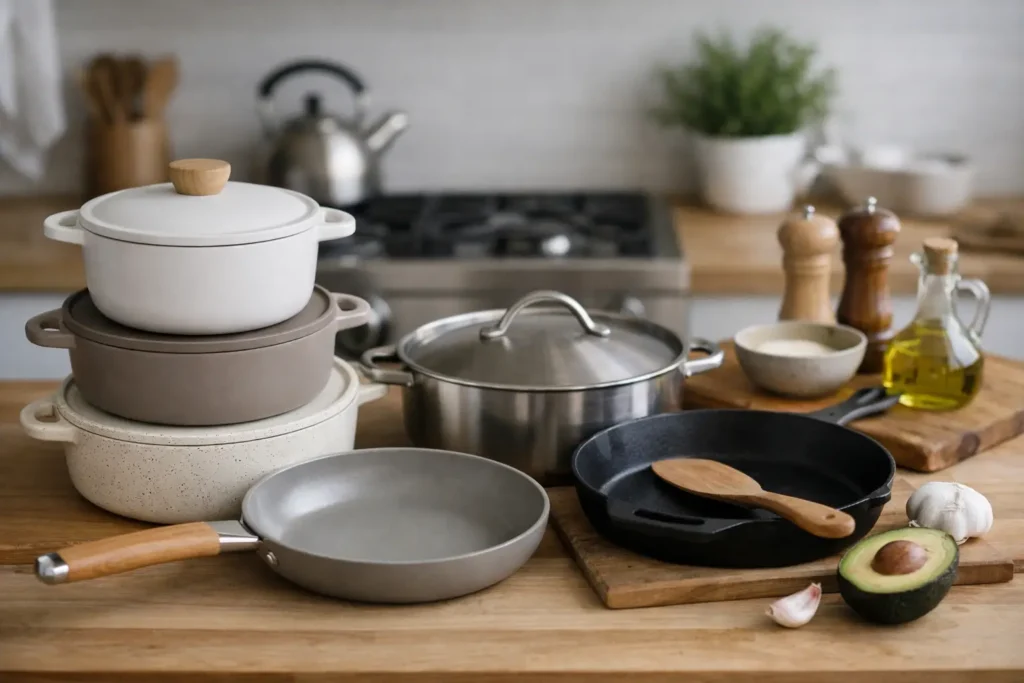
The skillet you use for Tuesday-night eggs matters more than a drawer full of kitchen gadgets. A guide to non toxic cookware should not push you to replace every pan overnight. It should help you identify what you own, understand the real trade-offs, and buy the next piece with more confidence.
“Non toxic” is a useful shopping term, but it is not a regulated cookware category. Brands may use it to describe everything from uncoated cast iron to a ceramic-coated nonstick pan. The better question is: What is this pan made of, what can it release when heated, and will it hold up to the way you actually cook?
Guide to Non Toxic Cookware: Start With the Material
The most dependable cookware choices tend to have simple, clearly disclosed materials. That does not mean every household needs the same set. A busy cook who wants quick cleanup may make a different choice than someone who regularly sears steaks or bakes sourdough.
Stainless steel is the practical everyday workhorse
Uncoated stainless steel is one of the easiest materials to recommend for daily cooking. It is durable, compatible with high heat, and does not rely on a nonstick coating. Look for fully clad or heavy-bottomed pans, which distribute heat more evenly and make scorching less likely.
The drawback is the learning curve. Stainless steel can stick if the pan is too cool, too hot, or not properly preheated. A small amount of oil and a patient preheat solve much of the problem. It is especially useful for sautéing vegetables, browning meat, simmering sauces, and deglazing flavorful browned bits.
Some people with a nickel sensitivity may prefer to research lower-nickel stainless options or choose another material for frequent use. For most households, though, quality stainless steel is a long-term, low-fuss foundation.

Why PO-Store Recommends It
The Cuisinart Chef’s Classic 10-Inch Open Skillet is the everyday stainless steel workhorse this guide calls for — no coating to wear out, no seasoning to maintain, and it holds up to daily use across every stovetop type. With #10 in Skillets on Amazon and 10,000+ customer reviews at a 4.3-star average, it’s a proven, trusted pick rather than an unfamiliar brand.
PROS
- 18/10 stainless steel cooking surface — doesn’t react with food or alter flavor, and never degrades the way a coating can
- Aluminum-encapsulated base spreads heat evenly and eliminates hot spots, so food cooks consistently
- Oven-safe up to 550°F and compatible with induction, gas, and electric cooktops
- Dishwasher safe, with a tapered drip-free rim for easy pouring
- Backed by Cuisinart’s lifetime limited warranty
- Cool-grip riveted handle stays comfortable on the stovetop
CONS
- Like all uncoated stainless steel, it has a learning curve — food can stick if the pan isn’t properly preheated or if too little oil is used
- Some buyers report sticking issues after the first few uses until they adjust their technique
- No lid included, so it’s best for open sautéing and searing rather than simmering
- Heavier than nonstick alternatives, which some users may notice during extended cooking sessions
Cast iron and carbon steel reward regular use
Cast iron and carbon steel are uncoated pans that develop a naturally slick seasoning over time. That seasoning is a layer of polymerized cooking oil, not a manufactured nonstick coating. Both are excellent for high-heat cooking, crisp-edged eggs, roasted vegetables, cornbread, and searing.
Cast iron holds heat exceptionally well but is heavy and slower to respond when you adjust the burner. Carbon steel is usually lighter and more responsive, making it a favorite for stir-fries, crepes, and quick stovetop meals. Neither is ideal for long, acidic simmers in a newly seasoned pan, because tomato, wine, or citrus can weaken the seasoning and affect flavor.
These pans need drying after washing and occasional re-seasoning. That is a fair trade for shoppers who want cookware that can improve with age rather than wear out after a few years.

Why PO-Store Recommends It
The Lodge 10.25-Inch Pre-Seasoned Cast Iron Skillet is Amazon’s #1 best-selling skillet, with well over 100,000 reviews and a 4.5+ star average — the kind of proven track record this guide points to when recommending uncoated cast iron. It arrives pre-seasoned and ready to cook, builds a naturally nonstick surface with use, and can genuinely last a lifetime with basic care.
PROS
- 100% cast iron with no synthetic coating — nothing to peel, flake, or break down at high heat
- Pre-seasoned with vegetable oil right out of the box, so it’s usable immediately
- Naturally nonstick surface improves the more you cook with it
- Extremely versatile: works on the stovetop, in the oven, on the grill, or over a campfire
- Includes a silicone hot handle holder for a safer, more comfortable grip
- Excellent heat retention, ideal for searing, crisp-edged eggs, and roasted vegetables
- Durable enough to be passed down for generations with proper care
CONS
- Heavy compared to stainless steel or carbon steel, which can be tiring for some users during extended cooking
- Slower to heat up and cool down, so it’s less responsive to quick burner adjustments
- Requires drying immediately after washing and occasional re-seasoning to maintain the nonstick surface
- Not ideal for long, acidic simmers (tomato sauce, wine-based dishes) in a newly seasoned pan, as it can strip the seasoning
- Not dishwasher safe
Enameled cast iron brings easy care, with a check worth making
Enameled cast iron has a glass-like coating fused to the cast iron base. It does not require seasoning, works well with acidic foods, and moves easily from stovetop to oven. Dutch ovens made from this material are particularly useful for soups, braises, beans, and bread.
The key is quality control. Avoid using enameled cookware with deep chips, cracks, or damaged interior surfaces. When comparing brands, look for clear information about testing and material standards, rather than relying only on broad wellness claims. Enameled pieces are also heavy, so consider whether you will realistically enjoy lifting a full pot from the oven.
Why PO-Store Recommends It
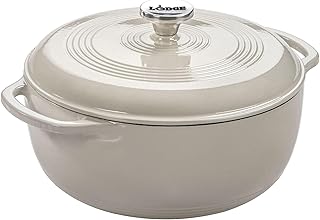
The Lodge 6-Quart Enameled Cast Iron Dutch Oven is a long-running Amazon bestseller with roughly 38,000+ reviews and a 4.7-star average. It delivers exactly the tradeoff this guide highlights for enameled cast iron: no seasoning required, safe with acidic ingredients like tomatoes and wine, and effortless movement from stovetop to oven — making it a natural fit for braises, soups, beans, and bread baking.
PROS
- Porcelain enamel coating handles acidic foods without affecting flavor or damaging the seasoning, unlike bare cast iron
- No seasoning or re-seasoning maintenance required
- Moves seamlessly from stovetop to oven, making it ideal for braising, slow cooking, and bread baking
- Moisture-sealing lid with self-basting spikes helps retain flavor and moisture during long cooks
- Dual handles make it easier and safer to lift, even when full
- Retains and distributes heat evenly, just like traditional cast iron
- Easier day-to-day cleanup than bare cast iron — no drying-and-oiling ritual after every wash
CONS
- Heavy, even more so than a bare cast iron skillet of similar size, which some users may find cumbersome to lift when full
- Enamel coating can chip if the pot is knocked around, dropped, or exposed to sudden temperature extremes — damaged interior surfaces should be retired
- Not ideal for high-heat searing on the same level as bare cast iron or carbon steel
- Pricier than an equivalent bare cast iron piece
- Hand washing is generally recommended over the dishwasher to preserve the enamel finish long-term
Glass and ceramic are useful specialists
Glass bakeware is a simple option for casseroles, reheating, and oven desserts. It does not work on a stovetop and can break with sudden temperature changes, so follow the manufacturer’s heating guidance. Let cold glass warm gradually and avoid setting a hot dish on a wet or cold surface.
Fully ceramic cookware can be appealing for oven use and food storage, but it is more prone to breakage and often less versatile than metal pans. If you choose ceramic, buy from a manufacturer that clearly identifies the product as food-safe and provides meaningful information about its glazes and testing.

Why PO-Store Recommends It
The Pyrex Deep 9×13″ Glass Baking Dish with Lid is a top-converting Pyrex bakeware pick on Amazon, with a 4.7+ star average and 500+ reviews. It’s the simple, single-purpose specialist this guide describes for glass bakeware — not a stovetop pan, but a dependable, non-reactive option for casseroles, reheating, and oven desserts.
PROS
- Tempered glass construction is non-porous and won’t absorb stains, odors, or flavors from food
- Safe for preheated ovens, the freezer, and the microwave, giving it more range than most bakeware
- Snap-tight lid doubles as an airtight seal for storing and reheating leftovers
- Deep design accommodates casseroles, lasagna, roasts, and layered desserts without overflow
- Dishwasher safe for easy cleanup
- Lets you see food as it cooks, unlike metal or ceramic bakeware
CONS
- Not stovetop safe — glass bakeware is oven- and microwave-only
- Can crack or shatter with sudden temperature changes (e.g., placing a hot dish on a cold or wet surface, or a cold dish straight into a hot oven)
- Heavier and more fragile than metal bakeware of a similar size
- Lid is plastic, so it isn’t oven-safe and should be removed before baking
What About Nonstick Pans?
Nonstick cookware deserves a more precise conversation than “good” or “bad.” Traditional nonstick pans are commonly coated with PTFE, a fluoropolymer. Modern reputable PTFE cookware is generally designed for normal household cooking temperatures, but it should never be overheated, preheated empty for long periods, or used under a broiler unless the maker specifically says it is safe.
At very high temperatures, PTFE coatings can break down and release fumes. That risk is a practical reason to reserve traditional nonstick for low- to medium-heat foods such as eggs, pancakes, and delicate fish. It is also a reason to keep pet birds far from the kitchen when any nonstick cookware is being used, since birds are unusually sensitive to fumes.
Ceramic-coated nonstick pans are often marketed as PFAS-free. Many shoppers prefer them for that reason, but “ceramic” does not automatically mean permanent or chemical-free. These coatings can lose their easy-release performance sooner than stainless steel, cast iron, or uncoated carbon steel, particularly when exposed to high heat or abrasive cleaning.
A nonstick pan can still be a sensible convenience tool. Just treat it as a limited-use piece, use silicone or wooden utensils, and replace it when the cooking surface is significantly scratched, peeling, or no longer intact. It should not be the pan you use for every meal.

GreenPan Chatham Hard Anodized Healthy Ceramic Nonstick, 8" Frying Pan Skillet, PFAS-Free, Dishwasher Safe, Oven Safe, Gray
Why PO-Store Recommends It
The GreenPan Chatham 8″ Hard Anodized Ceramic Nonstick Skillet is a PFAS-free option built on GreenPan’s Thermolon ceramic coating, giving it the easy-release convenience of traditional nonstick without PTFE. It fits exactly where this guide recommends ceramic-coated nonstick: as a dedicated, limited-use pan for eggs, pancakes, and delicate fish rather than an everyday workhorse.
PROS
- PFAS, PFOA, lead, and cadmium-free ceramic nonstick coating
- Hard-anodized body heats quickly and evenly, reducing hot spots
- Effortless food release for delicate items like eggs, pancakes, and fish, with minimal oil needed
- Dishwasher safe and oven safe, adding some flexibility beyond stovetop use
- Lighter weight than cast iron or stainless steel, easier for quick, everyday tasks
- Easy to clean, with less risk of stuck-on food than uncoated pans
CONS
- Ceramic nonstick coatings typically lose their easy-release performance faster than stainless steel, cast iron, or carbon steel, especially with high heat or abrasive scrubbing
- Not suited for high-heat searing or broiling the way uncoated metal pans are
- Coating will eventually degrade and need replacing, unlike materials that last indefinitely with care
- Metal utensils should be avoided to protect the coating, unlike bare cast iron or stainless steel
- Should not be preheated empty for long periods
Claims That Deserve a Closer Look
Marketing labels can make cookware shopping feel simpler than it is. “PFOA-free” is not the same as “PFAS-free,” and neither phrase explains every material in a pan. PFOA has been phased out of many manufacturing processes, so a PFOA-free claim alone tells shoppers relatively little about the finished product.
“Chemical-free” is another phrase to treat cautiously. Every cookware material is made of chemicals in the scientific sense. What matters is the specific material, the coating if there is one, the manufacturer’s stated temperature limits, and whether the company explains its safety standards clearly.
Be wary of vague product descriptions that never identify the cooking surface. A trustworthy listing should tell you whether a pan is stainless steel, bare cast iron, carbon steel, enamel, PTFE-coated aluminum, or ceramic-coated aluminum. If that answer is hard to find, it is reasonable to choose a more transparent brand.
Build a Safer Cookware Mix, Not a Perfect Set
Most real kitchens work best with a mix of materials. One good stainless steel skillet handles most weeknight meals. A stockpot or saucepan in stainless steel covers soups, pasta, and sauces. Add cast iron or carbon steel if you like high-heat searing, and consider an enameled Dutch oven if you cook braises or large batches.
If eggs and fish are regular parts of your routine, one carefully used nonstick skillet can be more practical than forcing every delicate meal into a pan you dislike. The goal is not purity at the expense of cooking at home. It is choosing materials intentionally and using each one within its strengths.
This approach also saves money. Instead of buying a matching 12-piece set with several pans you will rarely touch, invest in a few pieces with solid construction and useful sizes. For a couple or small household, an 8- to 10-inch skillet and a 3-quart saucepan may see more action than oversized cookware. Families may benefit from a 12-inch skillet and a larger Dutch oven or stockpot.
Care Habits That Make Cookware Last
Good cookware habits reduce wear regardless of material. Match the pan to the heat level, avoid metal utensils on coated surfaces, and do not shock hot cookware with cold water. Let pans cool enough to handle before washing, especially cast iron, enamel, glass, and ceramic.
For stainless steel, stuck-on food usually responds to a short soak and gentle scrub rather than aggressive scraping. For cast iron and carbon steel, dry thoroughly after washing and apply a very thin film of oil when needed. For nonstick, skip aerosol sprays when possible, since residue can build up on the surface over time.
There is no prize for keeping a damaged pan in service. Replace cookware with loose coatings, severe chips on the cooking surface, warped bases that cook unevenly, or handles that no longer feel secure. A pan should make dinner easier, not give you one more thing to second-guess.
The smartest cookware upgrade is usually the one that fits your stove, your meals, and your tolerance for cleanup. Start with the pan you reach for most, choose a material you understand, and let your kitchen earn its way toward a better collection.
Interested in more Home & Kitchen content?



Pingback: 6 Best Electric Lunch Boxes for Fresh Hot Meals | PO‑STORE
Pingback: Tired of Streaky Windshields? This Tool Makes Them Crystal Clear | PO‑STORE