

What’s in this guide:
✔ 6 air fryers reviewed, with pros and cons for each
✔ Picks for small kitchens, families, and everything in between
✔ A quick FAQ section at the end to help you choose
The difference between an air fryer you use four nights a week and one that ends up in a cabinet is rarely a flashy feature. It is usually basket space, cleanup, noise, and whether it cooks dinner without forcing you to run three separate batches. This air fryer review focuses on those everyday details so you can choose an appliance that earns its counter space.
Air fryers have moved beyond frozen fries and game-day snacks. For busy households, they can make crisp vegetables, reheat leftovers more successfully than a microwave, cook salmon quickly, and handle small meals without heating the whole kitchen. But the category is crowded, and larger capacity, more presets, or a lower sale price do not automatically mean a better fit.
Air Fryer Review: What Matters Beyond the Marketing
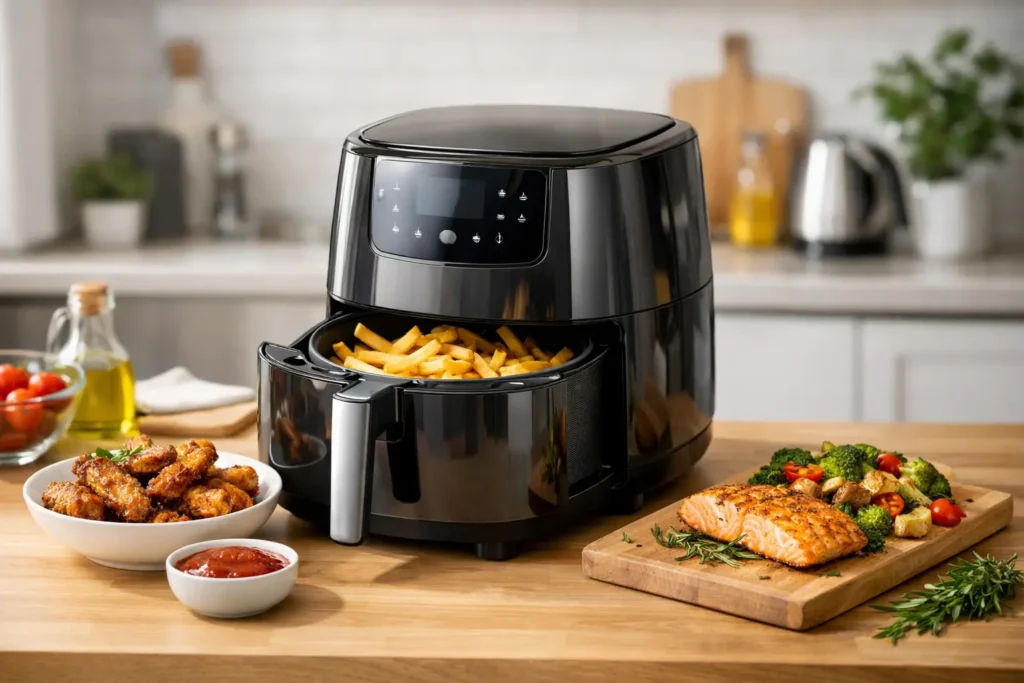
An air fryer is essentially a compact convection oven. A heating element and powerful fan circulate hot air around food, creating browning and crisp edges with little or no added oil. That basic idea works well, but the design around it determines how convenient the appliance feels.
The first question is not, “Which air fryer is best?” It is, “What will I realistically cook in it?” A single person who wants crisp tofu, chicken tenders, and reheated pizza has different needs from a family that wants to cook a full pound of wings or two portions of vegetables at once. Buying too small is the most common regret because overcrowding reduces airflow and produces uneven results.
A good air fryer should also make its strengths obvious. Controls should be easy to read, the basket should slide in smoothly, and the cooking surface should be simple to clean after a rushed weeknight meal. A long feature list has little value if you need the manual every time you want to raise the temperature.
Basket Style or Oven Style?
Most shoppers will choose between a basket-style air fryer and an air fryer oven. Neither is automatically better. The right option depends on available space, household size, and the kinds of food you make most often.
Basket air fryers are built for speed
Basket models are the practical choice for small households and anyone who wants fast, crisp results with minimal effort. They preheat quickly, use relatively little counter space, and are especially good for fries, vegetables, shrimp, chicken thighs, and reheating leftovers. Their drawer-style baskets also make it easy to shake food halfway through cooking.
The trade-off is capacity. A compact model may be perfect for one or two servings but frustrating when cooking for four. Even larger single-basket models can require food to be layered, which means shaking or turning is necessary for even browning.
Dual-basket air fryers solve part of that problem. They let you cook two foods at different temperatures or finish times, such as chicken in one drawer and vegetables in the other. That flexibility is genuinely useful for family meals. Still, two small drawers are not the same as one large cooking area, so they can be awkward for larger items like a full rack of ribs or a wide fillet of fish.
Air fryer ovens offer more flexibility
Oven-style units look like compact toaster ovens and often include racks, trays, rotisserie accessories, or settings for baking and toasting. They are a better fit for shoppers who want one appliance to cover several jobs, or who need to cook flatter foods in a single layer.
Their weakness is that they are usually less convenient for quick, everyday use. Racks can be messier to clean than a removable basket, and rotating trays during cooking may be more involved. They also take up more counter depth. If you already own a toaster oven you like, adding another large oven-style appliance may create more clutter than value.

Capacity Is More Than a Quart Number
Capacity labels can be misleading. Two air fryers with the same quart rating may have very different basket shapes, and shape matters when food needs room for air to circulate.
For one or two people, a 3- to 5-quart basket is usually enough for side dishes, snacks, and simple mains. A 5- to 7-quart model suits many couples and small families. For larger households, consider a roomy single basket, a dual-basket design, or an oven-style unit with multiple rack positions.
Think about the food you cook rather than the number printed on the box. Can the basket hold four chicken breasts without stacking them? Will it fit a pound of Brussels sprouts with enough room to crisp? Can you make enough fries for everyone without serving in shifts? Those questions lead to a more useful decision than capacity alone.
Cooking Performance: Crisping Is Only Part of the Job
A strong air fryer should brown food evenly, but real-world performance involves more than a dramatic first batch of fries. It should handle delicate foods without blasting them dry, maintain a stable temperature, and cook reliably from one batch to the next.
Frozen foods are where almost every decent air fryer performs well. The more revealing test is fresh food. Fresh vegetables need enough airflow to char lightly without shriveling. Chicken should develop color while staying juicy. Breaded foods should crisp without leaving pale spots underneath.
Temperature range matters, though not as much as brands often suggest. Most everyday recipes fall between 350 and 400 degrees Fahrenheit. A lower setting can help with gentler reheating or dehydrating, while a higher maximum temperature may improve browning. More useful than extreme temperatures is a model that responds predictably when you adjust time and heat.
Do not expect an air fryer to replace deep frying. It can deliver a satisfying crunch with far less oil, especially on breaded foods and naturally fatty ingredients, but it will not produce the exact texture of restaurant-style deep-fried food. That is not a flaw. It is simply a different cooking method with a different payoff: less mess, faster cleanup, and lighter everyday meals.
The Details That Make You Use It More Often
Convenience decides whether an appliance becomes part of your routine. Before buying, look closely at the basket, controls, footprint, and cleaning requirements.
A removable crisper plate is helpful because it lifts food away from drippings and allows hot air to reach the underside. It should be sturdy, easy to remove, and free of sharp corners where grease collects. Dishwasher-safe parts are useful, but hand-washing soon after cooking often keeps nonstick surfaces looking better over time.
Digital controls tend to be easier to set precisely than mechanical dials. Presets can be handy starting points, especially for common foods, but they are not a reason to pay extra. Cooking times vary with portion size, food moisture, and how full the basket is. The best controls make manual adjustments simple.
Noise is worth considering if you work from home or have an open kitchen. Air fryers use a fan, so none are silent, but some have a steadier, less intrusive sound than others. Also measure the space above and around the appliance. Heat and steam need room to escape, and a model that barely fits beneath a cabinet is not a comfortable daily-use choice.
Features Worth Paying For and Features to Question
A viewing window can be useful because it lets you check browning without opening the drawer and losing heat. Interior lights serve a similar purpose on oven-style units. Shake reminders are helpful for beginners, although they are not essential once you know your usual recipes.
Smart app controls sound convenient, but they are rarely a deciding feature. You still need to load the food, and many foods benefit from shaking or flipping partway through. For most people, dependable cooking, easy cleanup, and a well-designed basket matter more than Wi-Fi connectivity.
Accessories deserve the same skepticism. Racks, skewers, and baking pans can expand what an air fryer can do, but only if they fit the meals you actually make. A model should be worthwhile with its standard basket and tray. Accessories should add value, not compensate for a weak basic design.
Who Should Buy an Air Fryer?
An air fryer is a smart purchase for people who want quicker weeknight cooking, smaller-batch meals, and better leftover reheating. It is particularly useful in apartments, dorms, RVs, and homes where turning on a large oven feels excessive for a simple meal.
It may be less compelling if you primarily cook large family-style meals, already rely on a high-quality convection oven, or have limited counter space. In those cases, a compact basket model may still be worthwhile for snacks and sides, but it should not be treated as a full oven replacement.
The best choice is not the air fryer with the most modes or the biggest discount. It is the one sized for your household, simple enough to clean after dinner, and capable of cooking the foods you already reach for. Choose that well, and a weeknight side of crispy vegetables or a revived slice of pizza may be all the proof you need that it belongs in your kitchen.
Best Air Fryers: Our Top Picks

Why PO-Store Recommends It: The Cosori TurboBlaze is a 9-in-1 air fryer built around a 5-speed airflow system designed to cook food evenly without constant shaking or flipping. Its standout feature is the PFAS-free ceramic coating on the basket and crisper tray — a healthier alternative to traditional nonstick coatings that many shoppers now actively look for.
With a 6-quart capacity and a 90°–450°F range, it goes beyond air frying — roasting, baking, broiling, dehydrating, and even dough-proofing are all commonly associated with this model, making it a reasonable single-appliance swap for a few different countertop tools. The soft-start motor is designed to support quieter operation, and a safety lock is included for households with kids.
This is a straightforward pick for anyone who wants ceramic-coated cooking without a premium price tag, and who’s cooking for more than one or two people — the 6-quart basket comfortably handles family-sized portions.s
PROS
- PFAS-free ceramic coating
- 9 cooking functions in one appliance
- 6-quart capacity fits family-sized meals
- Quieter soft-start motor
CONS
- Larger footprint, may not suit small kitchens
- Turbo mode isn’t ideal for thin, lightweight foods
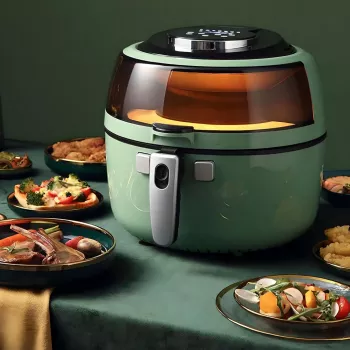
Revolutionary 6.5L High-Capacity Smoke-Free Air Fryer: Healthier Cooking at Your Fingertips
Why PO-Store Recommends It: This 6.5L air fryer is built around what the brand calls “stereo cycle” airflow technology, designed to circulate hot air around food for more even cooking without added oil. Its main draw is the combination of a large family-sized basket and a smokeless design, which is commonly associated with a cleaner-smelling kitchen compared to standard frying.
The 6.5L capacity is on the larger end for a countertop air fryer, making it well-suited for cooking bigger batches or multiple portions at once. It includes digital temperature control for dialing in results by dish, along with overheating protection as a built-in safety feature. The interior uses a PTFE non-stick coating, which is designed to make cleanup straightforward but is worth noting for shoppers who specifically look for PFAS-free or ceramic-coated alternatives.
This is a solid option for anyone who cooks for a larger household or batch-preps meals and wants a straightforward, no-frills air fryer without a lot of extra functions to learn.
PROS
- Large 6.5L capacity, good for families or batch cooking
- Smokeless design keeps kitchen air cleaner
- Simple digital temperature control
- Overheating protection built in
CONS
- PTFE coating, not PFAS-free like some ceramic models
- Fewer built-in cooking modes than multi-function competitors

Why PO-Store Recommends It: The Chefman TurboFry 2 Qt Mini Air Fryer is built for small-space cooking, using a compact convection design that’s rated to cook up to 400°F without preheating. Its core differentiator is size — this is a genuinely small-footprint appliance rather than a scaled-down version of a full-size fryer.
The capacitive touchscreen lets you set cooking time and temperature directly, and a built-in shake reminder is designed to alert you halfway through cooking for more even crisping. The nonstick basket and rack are dishwasher-safe, and automatic shutoff is included as a safety feature when the basket is removed or the timer runs out. At 2 quarts, it’s sized for single portions or snacks rather than family meals.
This is a well-regarded pick for solo cooks, small apartments, dorms, or anyone who wants an air fryer that won’t dominate counter space — it’s a straightforward, no-frills option rather than a multi-function appliance.
PROS
- Compact, space-saving footprint
- Touchscreen controls, simple to use
- Shake reminder for even cooking
- Dishwasher-safe basket and rack
CONS
- 2-quart capacity, too small for families
- Single cooking function (air fry only)
- Not suited for batch cooking or meal prep
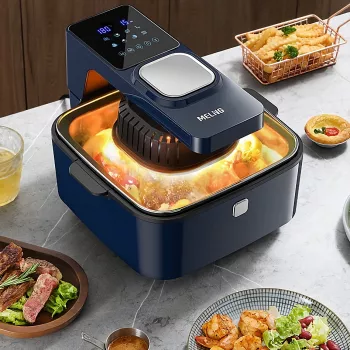
It’s designed to fry, bake, and roast with a non-stick, dishwasher-safe interior liner, and runs on 1100W for relatively quick heating. At 310x255x200mm and 2.9kg, it’s compact enough for most counters while still handling family-sized portions, and it’s CE certified for safety standards.
Note: This is a 220V appliance, which is standard in many countries outside the US but is not compatible with standard 110-120V US outlets without a compatible voltage converter. Confirm your outlet voltage and the unit’s plug type before ordering.
This is a well-regarded pick for shoppers in 220V regions who want a larger-capacity air fryer oven with the convenience of watching food cook in real time, rather than checking by opening the basket.
PROS
- Glass window for monitoring food while cooking
- Generous 8L capacity for larger meals
- Dishwasher-safe, non-stick liner
- Compact, lightweight design
CONS
- 220V only, not compatible with standard US outlets
- No shake or turn reminder
- Runs louder than some competitors

Why PO-Store Recommends It: The Ninja Air Fryer Pro AF141 is a compact 5-quart air fryer built around Ninja’s Air Crisp Technology, which circulates superheated air up to 400°F for crisping food with little to no added oil. Its core differentiator is simplicity — a straightforward 4-in-1 design rather than a crowded feature list.
It covers air frying, roasting, reheating, and dehydrating, with a ceramic-coated nonstick basket and crisper plate that’s dishwasher-safe for easy cleanup. Independent testing has noted its fast, even cooking performance is commonly associated with this model, and it’s rated to fit up to 4 lbs of fries or 5 lbs of chicken wings in a single batch. At 1,750W, it’s designed for quick preheating and cook times.
This is a well-regarded pick for smaller households or anyone who wants a compact, no-fuss air fryer that handles the everyday basics well without a steep learning curve.
PROS
- Fast, even cooking performance in independent tests
- Ceramic-coated, dishwasher-safe basket
- Compact footprint, fits smaller kitchens
- Simple 4-function controls, easy to learn
CONS
- Smaller capacity, best for 2-3 servings at a time
- No preheat reminder or shake alert
- No bake or broil function
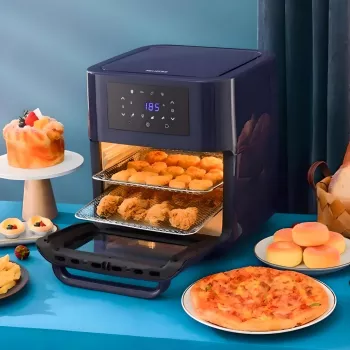
It runs at 1500W with touch-screen controls, a glass housing with an interior light for monitoring food without opening the door, and non-stick surfaces for easier cleanup. Beyond air frying, it’s commonly associated with roasting, baking, and rotisserie-style cooking, making it a reasonable single-appliance swap for an oven on nights when you don’t want to heat up the kitchen.
This is a straightforward pick for larger families, meal-preppers, or anyone who regularly cooks multiple dishes at once and wants oven-style versatility without the full size or heat of a conventional oven.
PROS
- Large 12L capacity, fits multiple dishes at once
- Multi-shelf, oven-style design
- Glass door with interior light for monitoring
- Rotisserie function included
CONS
- Larger footprint than basket-style air fryers
- Some racks reported as flimsy for larger items
- Bulkier, needs more counter or storage space
Air Fryer Frequently Asked Questions
It depends more on what you cook than the quart number on the box. A 3‑ to 5‑quart basket is usually enough for one or two people. A 5‑ to 7‑quart model suits couples and small families. For larger households, a roomy single basket, dual‑basket design, or oven‑style unit with multiple racks tends to work better. Overcrowding a basket is the most common mistake, since it blocks airflow and leads to uneven cooking.
Neither is universally better. Basket models preheat faster, take up less space, and work well for fries, vegetables, and reheating leftovers. Oven‑style units offer more flexibility, with racks and settings for baking, roasting, or rotisserie cooking, but they’re generally less convenient for quick everyday use and take up more counter depth.
Not exactly. An air fryer can deliver a satisfying crunch with far less oil, especially on breaded foods, but it won’t produce the exact texture of restaurant‑style deep frying. It’s a different cooking method with a different payoff: less mess, easier cleanup, and lighter everyday meals.
All air fryers make some noise because they rely on a fan, but noise levels vary by model. If you work from home or have an open kitchen layout, it’s worth checking noise details before buying, along with the clearance space above and around the unit, since heat and steam need room to vent.
Not necessarily. Shake reminders can help beginners, but they’re less essential once you’re familiar with your usual recipes. App controls are often more of a novelty than a practical feature, since you still need to load the food and shake or flip it partway through cooking either way.
A removable, sturdy crisper plate that lifts food away from drippings makes a big difference. Dishwasher‑safe parts are convenient, though hand‑washing nonstick surfaces soon after cooking is often associated with keeping them in better condition over time.
Not as much as marketing suggests. Most everyday recipes fall between 350°F and 400°F. A model that responds predictably when you adjust time and temperature tends to matter more day‑to‑day than an extreme top‑end temperature.




Pingback: How to Set Up Leak Sensors Without Missing Risks | PO‑STORE
Pingback: Healthy Office Snacks List for Better Workdays | PO‑STORE