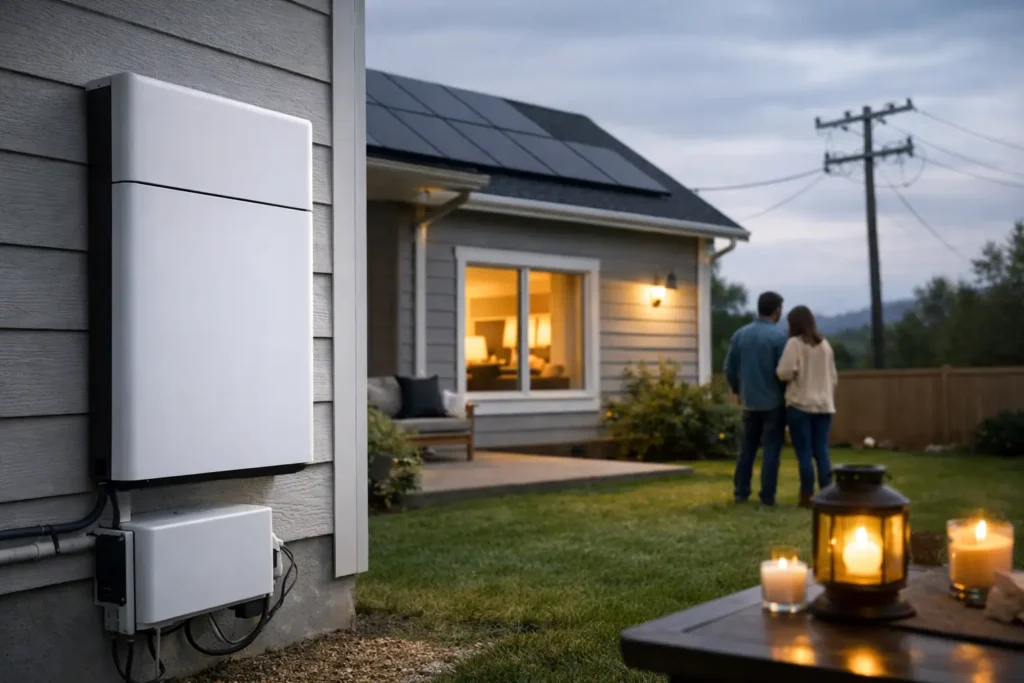
The power goes out at 7:12 p.m. The fridge is full, your phone is at 18%, and suddenly every product page for backup power starts to look the same. This is exactly where a home battery backup for outages stops feeling like a nice-to-have and starts feeling like a practical home upgrade.
For many households, the real question is not whether backup power is useful. It is what kind of backup actually makes sense. A whole-home battery system can keep essentials running quietly and automatically, but it is not the right fit for every budget, layout, or outage pattern. The smart buy depends on what you need to power, how long outages usually last, and whether you want battery alone or battery paired with solar.
What a home battery backup for outages actually does
A home battery stores electricity for later use. When the grid goes down, the system switches over and sends stored power to selected circuits or, in some cases, the whole house. Unlike a gas generator, it does not need fuel deliveries, it does not produce exhaust, and it is much quieter.
That sounds simple, but the details matter. Some systems are built only for short outages and essential loads like lights, Wi-Fi, refrigeration, and device charging. Others are sized to run central air, well pumps, kitchen appliances, and more. The difference usually comes down to battery capacity, inverter power, and how your electrical panel is set up.
For shoppers comparing options, the biggest misunderstanding is assuming battery backup means unlimited power. It does not. A battery gives you a fixed amount of stored energy. If you run high-draw appliances nonstop, that stored energy goes quickly. If you focus on essentials, the same battery can carry you much longer.
Why more homeowners are choosing batteries over generators
There is a reason battery backup has moved from niche upgrade to serious consideration in mainstream homes. Convenience is a big part of it. Most systems switch on automatically, so you do not need to wheel out equipment, pour fuel, or start anything in bad weather.
There is also the day-to-day value. A generator sits idle until you need it. A battery can often do more. Depending on your utility setup, it may help store solar energy, reduce peak electricity use, or provide backup without the maintenance headache that comes with combustion equipment.
That said, generators still win in some scenarios. If you live in an area with multi-day outages and need to power large HVAC systems, electric water heating, or a large home continuously, a generator may be the more cost-effective answer. Batteries are excellent for clean, instant backup, but they can get expensive as energy demands rise.
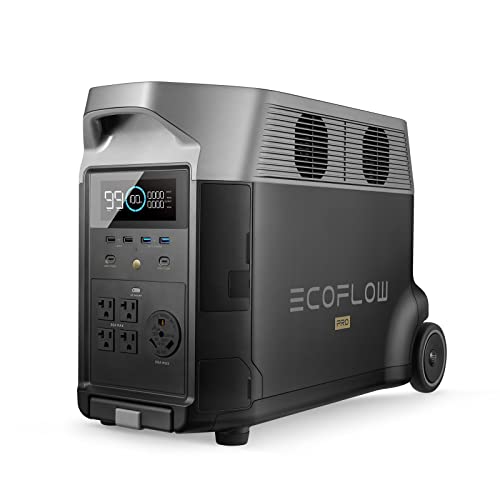
DELTA 2 The Ultimate Portable Powerhouse for Everyday Essentials
- Capacity: 1,024Wh (Expandable up to 3,040Wh)
- Output: 1,800W continuous (2,700W Surge)
Blazing Fast Charging: Charges from 0% to 80% in just 50 minutes—the fastest in the industry.
Everyday Reliability: Powers 90% of standard home appliances, including your refrigerator and microwave.
10-Year Lifespan: Built with premium LiFePO4 cells that last for over 3,000 cycles of daily use.
Highly Portable: Lightweight design makes it perfect for quick emergency backups, tailgating, or camping trips.
How to tell if your home is a good candidate
A battery system makes the most sense when outages are frequent enough to justify the cost, when you care about quiet operation, or when you want backup for essentials without dealing with fuel. It is also a strong fit for homes that already have solar or plan to add it.
If your outages are rare and brief, the value equation changes. You may still want one for peace of mind, especially if you work from home, store medication that needs refrigeration, or have unreliable utility service. But if your main goal is occasional emergency power for a few devices, a smaller portable power station might be the better buy.
Home layout matters too. Newer electrical panels and simpler load planning usually make installation easier. Older homes can still use battery backup, but upgrades may be needed, which pushes total cost higher.
Sizing a home battery backup for outages
This is where smart shoppers save themselves from buying too little or paying for too much. Battery size is usually discussed in kilowatt-hours, which tells you how much energy is stored. Power output, measured in kilowatts, tells you how much the battery can run at one time.
Think of it this way. Capacity is the size of the tank. Power output is how wide the pipe is. You need enough of both.
A modest backup setup might cover your refrigerator, internet, some lighting, phone charging, and a few outlets. That can be enough for many families during a short outage. If you want to add a sump pump, microwave, garage door, or portable AC, your needs increase. If you expect to run central air, electric range cooking, laundry, or a large well pump, the system gets significantly larger and more expensive.
The practical move is to separate must-haves from nice-to-haves. Most people do not need whole-home backup as much as they think they do. They need comfort, food safety, connectivity, and a little normalcy. That distinction keeps a project grounded.
Start with your essential loads
Before comparing brands, make a simple list of what matters during an outage. For most homes, that includes refrigeration, lighting in key rooms, internet, phone charging, and possibly a medical device, sump pump, or home office setup. If you live in a hot climate, cooling may move from luxury to essential.
Once you know the essentials, you can estimate how long you want them powered. A few evening hours is different from making it through a 24-hour outage. This is why two homes with similar square footage can need very different systems.
Whole-home backup sounds great, but it is not always necessary
Whole-home backup is appealing because it feels simple. No trade-offs, no circuit planning, no surprises. But it often means paying to support loads you do not truly need in an outage.
Many homeowners are happier with partial-home backup tied to essential circuits. It lowers costs, stretches runtime, and still covers the functions that matter most. For a lot of households, that is the sweet spot.
Battery-only vs. battery plus solar
A battery without solar can still provide backup power. It charges from the grid and waits for an outage. That works well for shorter interruptions and for homeowners who want a cleaner alternative to generators.
Pairing a battery with solar adds a major advantage. During a prolonged outage, solar panels may recharge the battery during daylight hours, depending on the system design and weather. That can turn limited backup into something much more resilient.
Still, solar is not a magic answer. Cloudy conditions reduce production, and not every solar setup automatically supports outage charging. Some grid-tied solar systems shut down during outages unless they are specifically designed with battery backup and islanding capability. This is one of those details that sounds technical but makes a huge real-world difference.
What to look for when comparing systems
Marketing around backup power gets crowded fast, so it helps to focus on a few practical factors. Runtime claims are only meaningful if you know what is being powered. A battery that sounds large on paper may feel small if your home relies on heavy electric loads.
Pay attention to usable capacity, not just total capacity. Check whether the system can handle surge loads from appliances like refrigerators or pumps. Ask how the switchover works during an outage and whether backup is truly automatic.
Warranty terms matter more than flashy app features. So does installer quality. A strong battery paired with poor system design is still a bad experience. This is one category where product quality and installation quality are tightly linked.
Noise level, footprint, and placement should also be part of the decision. Some systems mount neatly on a garage wall. Others need more floor space or specific environmental conditions. If space is tight, those details can narrow your options quickly.
Cost, trade-offs, and what is worth paying for
Home battery backup is not the cheapest home upgrade, and there is no honest way to frame it as one. Costs vary widely based on battery size, panel work, labor, and whether solar is included. The more loads you want covered, the faster the price climbs.
What you are really paying for is a combination of convenience, quiet operation, instant response, and cleaner energy storage. For some buyers, that is absolutely worth it. For others, especially in areas with rare outages, a generator or smaller backup product delivers better value.
The smartest buyers are usually the ones who resist overbuying. They choose a system around real outage priorities, not the fantasy of running everything exactly as usual. That often leads to a setup that feels more affordable and more useful.
The bottom line for shoppers
If you want backup power that is quiet, automatic, and easy to live with, a home battery backup for outages is one of the most practical options on the market. The catch is that the right system is not defined by the biggest battery or the longest feature list. It is defined by fit.
For most households, the best choice is the one that keeps essential loads running, matches local outage patterns, and leaves enough room in the budget for proper installation. That is usually a better outcome than chasing whole-home backup just because it sounds safer on paper.
A good backup system should make your home feel less fragile when the grid fails. If it does that without adding complexity you will regret later, you are probably looking in the right place.
Our Rating:
3.5 | Our Rating:
3.5 | Our Rating:
3.5 | Our Rating:
3.5 |
Pros:
| Pros:
| Pros:
| Pros:
|
Cons:
| Cons:
| Cons:
| Cons:
|
- Basic Essentials & Portability
- 1,024 Wh
- AC Output Power 1,800W
- Fridge, Wi-Fi Router, Phone Charging
- The small 1,024Wh capacity drains quickly if you plug in heavy heating or cooking appliances.
- Partial-Home Circuit Backup
- 3,600 Wh
- AC Output Power
- 3,600W
- Sump Pumps, Microwaves, Portable AC
- It lacks native 240V output, meaning you need to purchase expensive external accessories or link two units together to power heavy-duty appliances like central AC or well pumps.
- Heavy-Duty 240V Home Backup
- 4,000 Wh
- AC Output Power
- 4,000W
- Central HVAC, Well Pumps, Full Kitchen
- It carries a high entry price point that may be difficult to justify for households that only experience rare, brief blackouts.
- High-Output & EV Charging
- 3,840 Wh
- AC Output Power
- 6,000W
- Well Pumps, EV Charging, Central AC
- Weighing in at roughly 132 lbs, its heavy physical footprint makes it difficult for a single person to lift up stairs or transport over rough outdoor terrain.